Global outreach April 28, 2026
Speed-Limit Sign Condition Monitoring using Edge AI
Liability Risks Arising from Infrastructure Defects
Governments at all levels - local, state, and federal - face increasing liability risks stemming from infrastructure defects. Demonstrating due diligence has become essential to defend against legal claims and ensure accountability in public safety.
Speed-limit signs are a clear example. When speed enforcement citations are issued, authorities must be able to provide verifiable evidence that the relevant sign was present and visible at the time of the violation. Missing, vandalized, or obscured signs can lead to inconsistent enforcement and potential disputes.
NYC DOT Innovation Studio
This is not so different for New York City Department of Transportation. Managing over 6,000 miles of streets and more than 13,000 signalized intersections - along with the nation’s largest automated enforcement program - the City has been actively piloting innovations that can further enhance safety and infrastructure management.
In this line, NYC DOT, in partnership with Newlab, launched an open innovation program inviting startups to pilot AI-enabled solutions for smarter street management. Dareesoft was selected in September 2025 and deployed a four-month pilot focused on automated speed-limit sign detection, culminating in a successful public showcase on March 25, 2026.
Speed-Limit Sign Condition Monitoring Pilot Project
As part of the pilot, three ARA-30 devices were installed on NYC DOT patrol vehicles operating across Manhattan, Brooklyn, and Queens. Each device was mounted on the interior windshield and continuously captured images and GPS data during patrol operations.
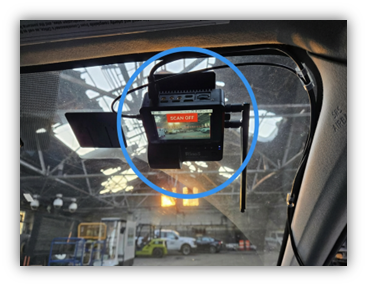 ARA-30 Installed on NYC DOT Patrol Vehicle
Between November 2025 and March 2026:
- 325,212 images were captured across 106 runs
- Data was collected at approximately 5-meter (17-foot) intervals
- 44,383 raw detections were identified and refined into 2,496 unique sign instances using Dareesoft’s proprietary deduplication algorithm
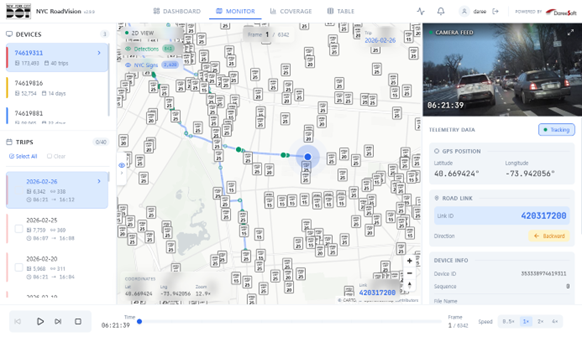
[Image Replay Interface (17-Foot Intervals)]
The system identified 90 damaged signs, broadly categorized into four types:
- Physical damage
- Obstruction by vegetation
- Obstruction by adjacent structures
- Stickers or graffiti
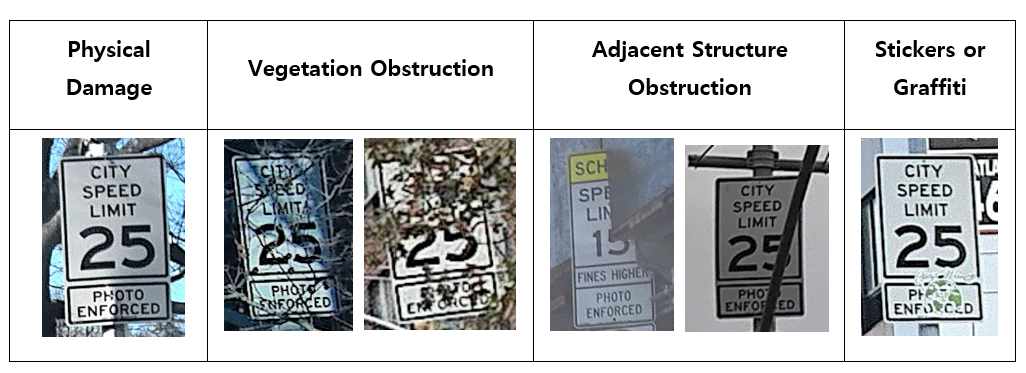 Speed Limit Signs Anomalies
By comparing field data with existing reference databases, the system also identified inconsistencies, helping maintain an accurate and up-to-date database.
All key performance indicators (KPIs) were successfully achieved:
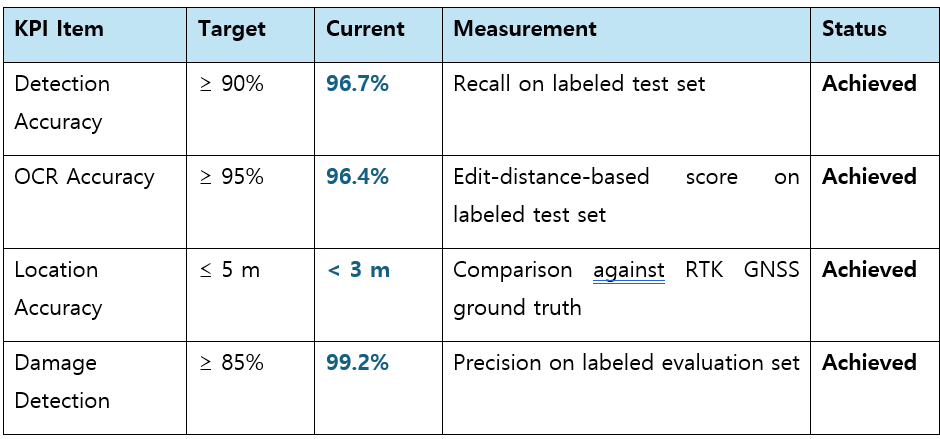 NYC DoT KPI table
Dareesoft’s Core Technology – ARA-30 and VisionX
The success of this pilot is rooted in Dareesoft’s integrated hardware and software capabilities.
At the edge, the ARA-30, Dareesoft’s proprietary AI Road Analyzer, enables real-time data processing. With an AI processing speed of 15 TOPS, the device can run complex models and analyze data instantly. Its 4+1 channel global shutter camera minimizes blind spots and captures high-resolution, sharply detailed imagery, even at speeds exceeding 70 mph.
High-quality image capture is critical. No matter how advanced the AI model is, poor input data leads to compromised results. By ensuring consistent, high-precision image acquisition, ARA-30 establishes a strong foundation for downstream analytics.
On the software side, Dareesoft’s Vision-Language Model, VisionX, significantly enhances scalability and efficiency. In this pilot, VisionX was used in the early stages to build a dataset for training the speed-limit sign detection model.
As explained by Dareesoft AI developer Sohee Moon, one of the company’s female engineers contributing to the project: “Finding and individually labeling speed limit sign images from approximately 155,000 road photos would normally require a tremendous amount of time. However, by leveraging VisionX, we were able to pre-filter the dataset and narrow it down to about 12,000 images.”
This first-pass auto-labeling approach dramatically reduced manual effort and accelerated model development.
Scalability Beyond Speed-Limit Signs
The true strength of VisionX lies in its scalability.
Traditional CNN-based object detection models require extensive labeled datasets and can only detect predefined object classes. Expanding to new asset types often involves a time-consuming cycle of data collection, labeling, and retraining.
VisionX takes a different approach. Pre-trained on large-scale image-text datasets, it supports open-vocabulary detection, enabling the identification of objects beyond predefined classes. This allows agencies to quickly adapt the system to new use cases without extensive retraining.
While VisionX was used here primarily for dataset construction, Dareesoft is actively exploring broader applications across various infrastructure and asset monitoring scenarios.
From Monitoring to Accountability
As cities expand data-driven operations, the ability to verify infrastructure conditions at a specific point in time is becoming critical. Liability today depends not only on maintaining assets, but on maintaining credible, traceable records.
Importantly, AI is not a replacement for human expertise. Instead, it serves as a tool to enhance visibility and reduce manual burden, enabling engineers and operators to make more informed, evidence-based decisions.
By combining edge AI with VisionX, Dareesoft enables continuous monitoring while supporting expert validation and prioritization. This allows governments to confidently gauge infrastructure conditions and demonstrate due diligence, ultimately reducing liability while preserving the essential role of human oversight.